
College affordability
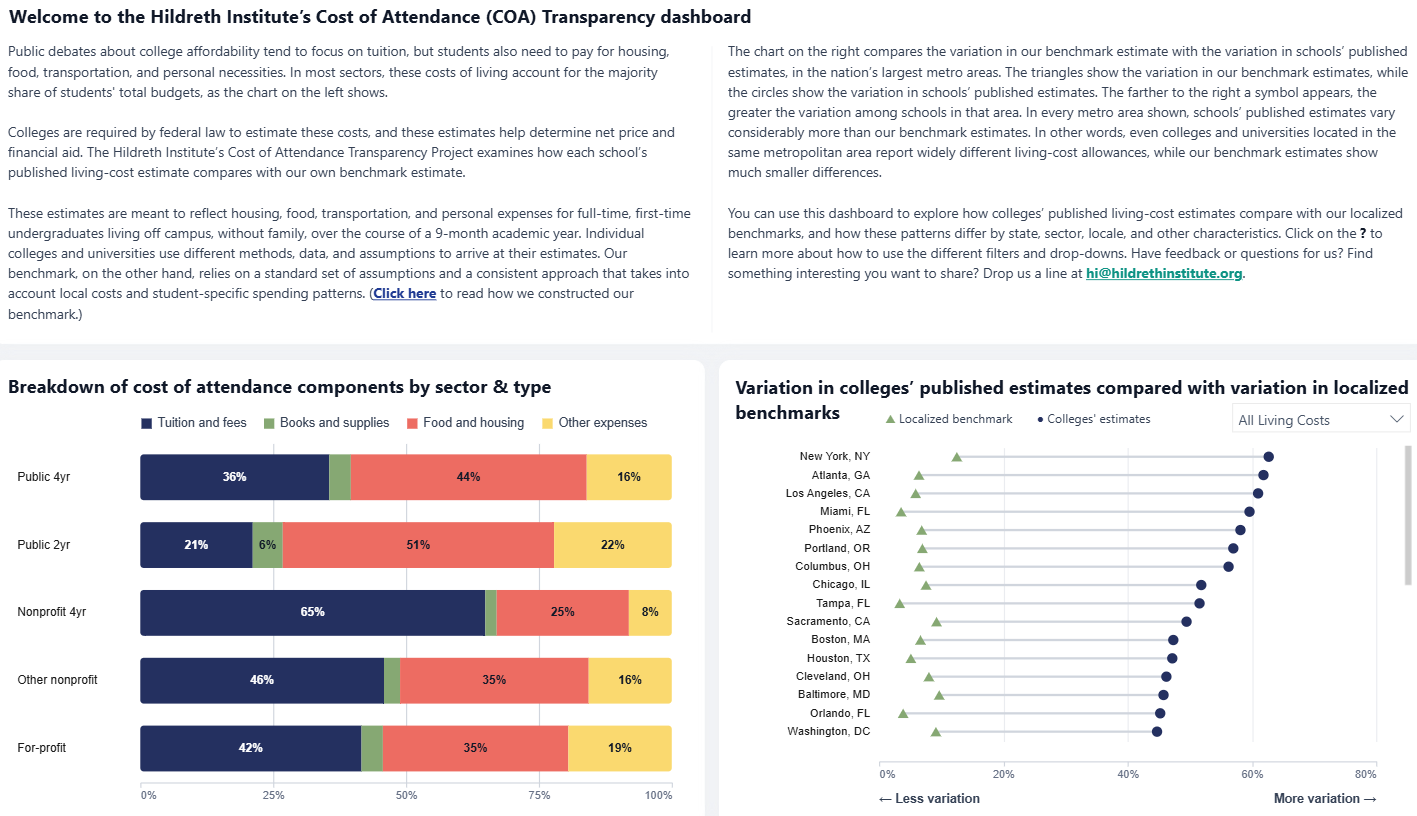
Examining institutional Cost of Attendance estimates against localized living-cost benchmarks to understand variations in how colleges account for students' living expenses.
Policy research · Higher education · Student debt
Transforming higher education, financial, and public-opinion data into accessible analytical insights for research on college affordability and student debt.
01 / The challenge
The cost of attending college extends beyond tuition. Living expenses, institutional cost estimates, financial aid, and student borrowing all influence college affordability.
However, inconsistent reporting and fragmented financial data make it difficult to understand the true financial burden faced by students. The challenge was to make these data more accessible and interpretable to support research into higher education affordability and student debt.
02 / Connecting financial data
Examining institutional Cost of Attendance estimates against localized living-cost benchmarks to understand variations in how colleges account for students' living expenses.
Exploring student borrowing, debt burdens, and public responses to federal student loan policies to illuminate challenges within the higher education financing system.
Connecting financial and institutional data to meaningful analytical insights that can inform policy discussions and evidence-based decisions.
03 / Making policy data accessible
I contributed to the development of interactive analytics and data visualization experiences that allow stakeholders to explore economic and educational trends.
The Cost of Attendance dashboard enables comparisons between institutional living-cost allowances and localized benchmarks, with exploration across states, institutional sectors, and geographic contexts.
The goal was to move beyond static reports and provide an interactive way to examine patterns, identify disparities, and investigate questions relevant to higher education affordability.
04 / The student debt landscape
I also worked within the broader analytical context of federal student loans and student debt, examining how borrowing, repayment policies, and borrower experiences intersect with higher education affordability.
This research included exploring public sentiment surrounding student loan relief policies through large-scale social listening and AI-supported text analysis.
The objective was to identify patterns in public opinion and borrower concerns that could inform discussions about student debt relief, loan servicing, and policy reform.
05 / From analytics to policy insights
This work demonstrates how data analytics and interactive visualization can support evidence-based policy research. By making complex financial and educational data more accessible, the project helps researchers and policy stakeholders examine affordability challenges, understand student debt, and identify opportunities for more equitable higher education policies.